Intro
I don’t know how I didn’t posted about this before, but it’s quite interesting to post about Google Open Source. I remember when I heard about the Summer Camp for the first time by Suchakrapani, man, it was amazing.

I don’t know how I didn’t posted about this before, but it’s quite interesting to post about Google Open Source. I remember when I heard about the Summer Camp for the first time by Suchakrapani, man, it was amazing.
If I might use my blog for anything, so now it comes to my mind talk about a designer that I call when needing design stuff. Like she’s a pro and gets stuff done.

She had projects for several places, including Parks Canada. She has her own style, which is quite interesting. I not versed in Design stuff but it’s simple and similar to Japanese and reminds of UNIQLO.

I remember when I needed to do small deployment, I would use GlassFish. In the beginning it was quite annoying, but you get used to it.
Complaining at the asadmin because it was deploying my war, even it was not my fault. The console is quite intuitive though, very nice and useful.
asadmin: it’s the administrative utility for Oracle Glassfish. To deploy, just do:
~~~
asadmin deploy war-name
~~~
The Adminstration Guide is here, btw.
mod_jk
It can be used with mod_jk, which is this plug-in that handles the communication between Tomcat and Apache.
Well, ok, Francisco, and compared to JBoss, how is it?
I won’t say anything, please see the experts answer.
Well, I personally used only GlassFish, and I prefer the name GlassFiss over Payara. I’m sure there is a reasonable explanation for this name though. On their website there isn’t any dot in Brazil, that might explain why I don’t like the name. PR stuff in SA is not as good.
I think it is worth digging in the known issues of the servers, just in case. Quite annoying that you might have issues by setting java.security.debug as option on the jvm.
I found this quite interesting project done by Adam Bien. It is called loadr, which is a utility to deploy applications in Glassfish/Payara.
It’s similar to asadmin, but uses REST interface and it is self-contained JAR, which accordingly to the author is very useful fro CI environments.
The Git hub is here
inline
JRE and JDK what is the difference and why it’s a bit confusing! lol!
The diagram below summarizes: basically, JDK is a superset of JRE.
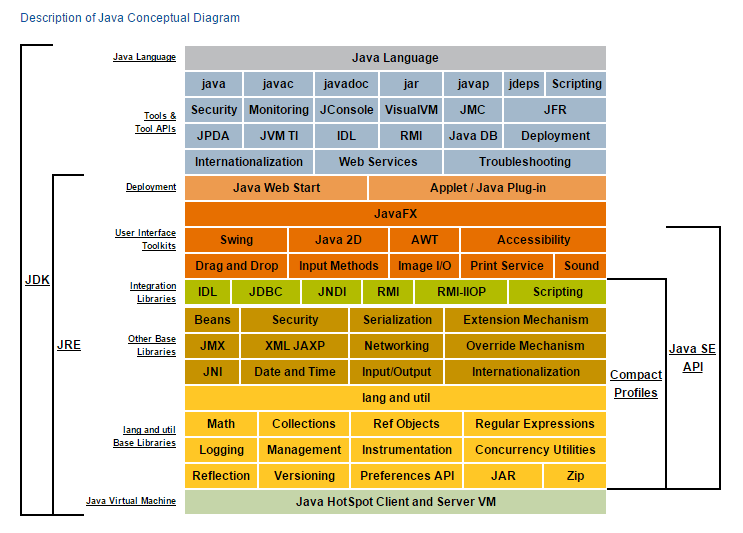
Well, if you want to use Tool and Tools API, you will need JDK. Dot.
Use the commands below to install JRE and JDK
OpenJRE
sudo apt-get install openjdk-8-jre
OracleJDK
sudo apt-get install oracle-java8-installer
OpenJDK
sudo apt-get install openjdk-8-jdk
Setting JAVA_HOME
echo “JAVA_HOME=$(which java)” | sudo tee -a /etc/environment
Our paper, Non-Scrum Implementation: A Methodological Approach for Small Companies, was accepted at the conference 18th European Conference on Research Methodology for Business and Management Studies, aka ECRM19.
Thank you very much to all involved!
See you guys in Johannesburg – South Africa
Debug using gdb for Apache
pstack is this quite an interesting tool for debugging in case you don’t want to trace the server. Basically this command command shows a stack trace for each process!! Similar to gstack but for RHEL.
pstack <pid>
Example stolen from Oracle to demonstrate nfsd
243:    /usr/lib/nfs/nfsd -a 16
 ef675c04 poll     (24d50, 2, ffffffff)
 000115dc ???????? (24000, 132c4, 276d8, 1329c, 276d8, 0)
 00011390 main     (3, efffff14, 0, 0, ffffffff, 400) + 3c8
 00010fb0 _start   (0, 0, 0, 0, 0, 0) + 5c
On this case we can see that last function is pool, called from ??? – without ELF info – which was called by main.
The reading follows the simple rule:
The bottom is the start –> the top is the last call
inline
Although I already talked about this before, I think it worth mentioning – I talked before about Chaos Monkey and the Simian Army, but there are actually some interesting principles around Chaos Eng actually worth mentioning.
It is the discipline to run several tests on production in order to make it robust and foresee issues – the first is basic for any scientific experiment. This has started on Netflix, but it’s quite interesting and now has spread all over.
The main principles are the following ones:
I think for large scales application, those kinds of tests are very important and even Forbes made a report about it. Minimizing the blast radius of the issues that the system might face is quite an interesting highlight here.
Reference Book
I didn’t read it but it’s on my reading list: Chaos Engineering – by Ali Basiri, Nora Jones, Aaron Blohowiak, Lorin Hochstein, Casey Rosenthal
inline.
I think it’s quite interesting that we can have private repositories with up to 3 people in git. That’s very useful. I would like to have 4, but 3 is ok.
The instructions are here
I recently posted that with some python libs. I think beautifulsoup is on this list.
Beautifulsoup is this very nice thing treat html content, quite nice. The code below takes the the content from hmtl and returns the content without html tags.
from bs4 import BeautifulSoup
#Get Content
def get_content(url="test\solution.html"):
    #content = urllib.request.urlopen(url).read()
    #soup = BeautifulSoup(content, features="html.parser")
    soup = BeautifulSoup(open("test\solution.html"), "html.parser")
    return soup.text
To do queries on google search is quite simple, with this lib – the query is done as below:
query
domain
number of results
search(query, tld="com", num=n_result, stop=1, pause=2):
inline
I have created a small server.log parser for JBoss with Gabriel A., my wingman.
It’s small and growing on demand, contributors are more than welcome.
This helps to parse server.log files to find exceptions and faster. Actually any file with errors, indeed.
Very small stuff, but we will improve upon that.
[1]https://github.com/FranciscoMeloJr/Python-Tests/tree/master/helper

